The authentic and timeless world of Ralph Lauren
Fall 2026
RL/Culture

Georgia on Lake George

Before Ghost Ranch, a young Georgia O’Keeffe ventured to a family cabin upstate, where early musings on beauty and confinement would lay the foundation for her relationship to nature.
Autor: Annie Armstrong
The state of true repose, for a working artist, is often torturous. For the non-artists among us, a vacation encourages immersion into nature and beauty, the very things that give artists their inspiration. What is an artist to do when they are surrounded by nature, but expected to relax? This is the paradox at the center of Georgia O’Keeffe’s time at Lake George, which she regards in equal turn as vacation and a reticent obligation. “If I hadn’t other things that I want to finish here from other years,” she wrote to her friend, the novelist Sherwood Anderson, “I would much prefer Maine.”
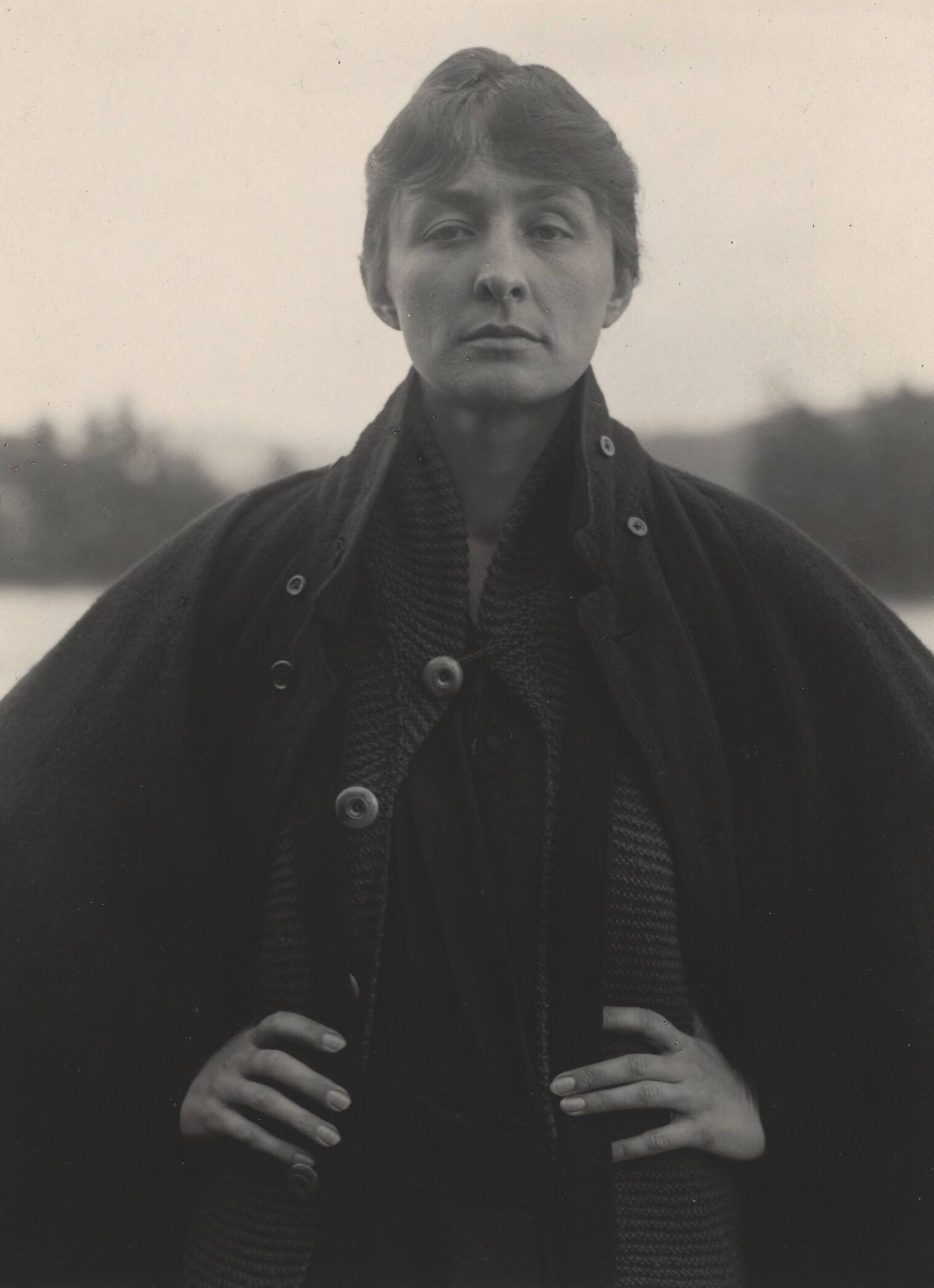
Photo: National Gallery of Art, Washington, Alfred Stieglitz Collection.
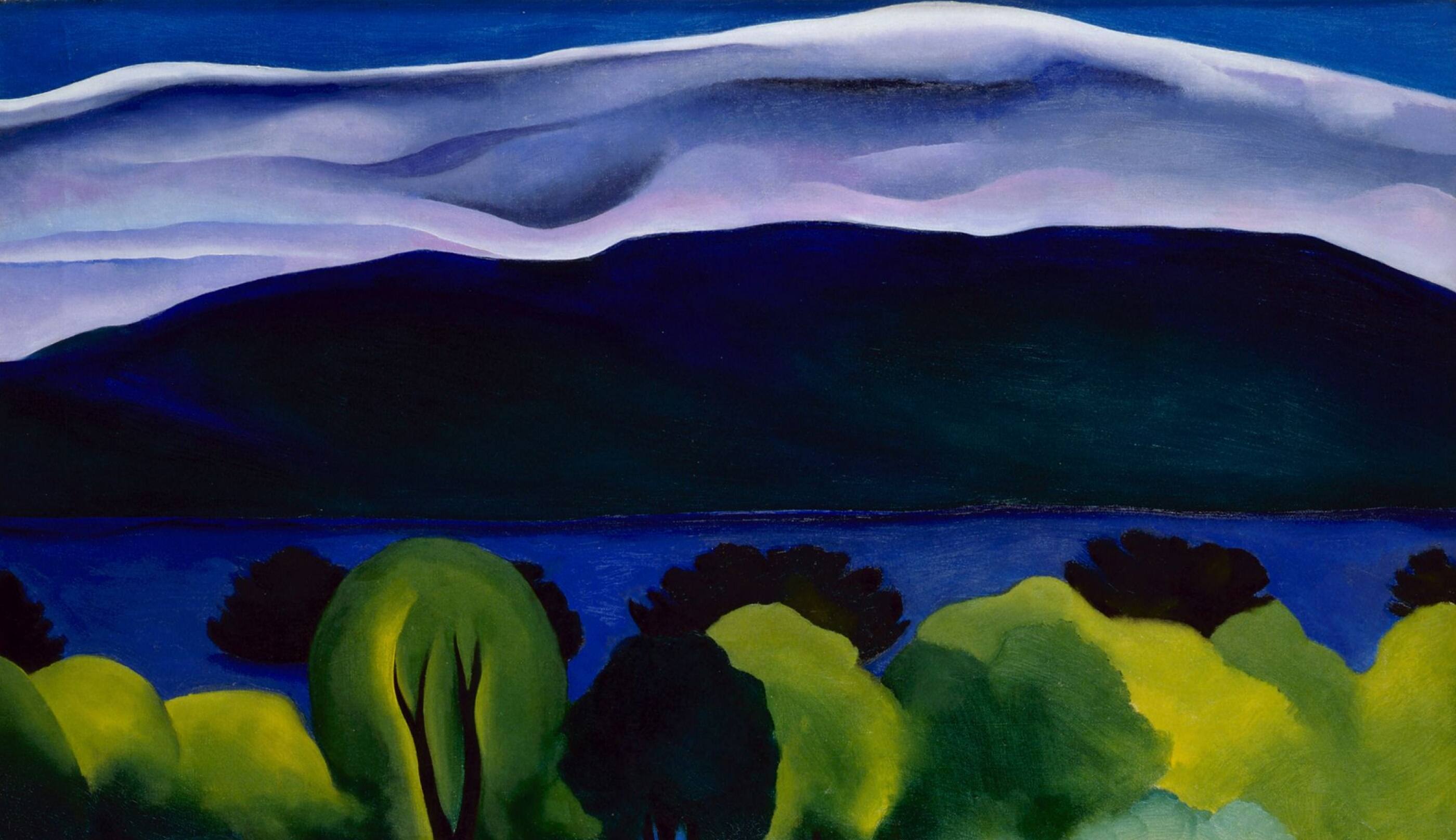
Illustration: Georgia O’Keeffe. Lake George Blue, 1926. Oil on canvas, 18 x 30 inches. Private Collection. © Georgia O’Keeffe Museum.
The Way They Were
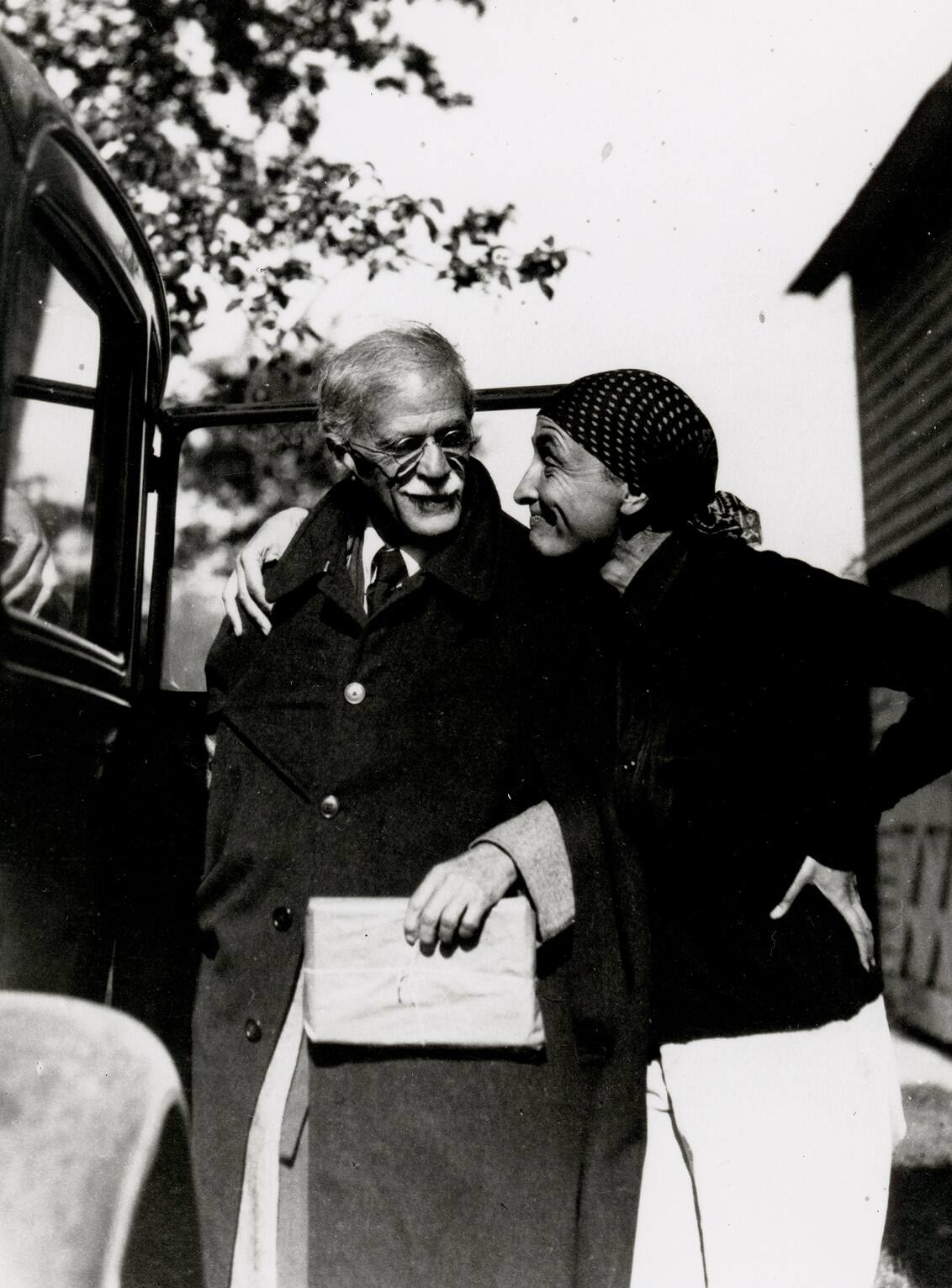
O’Keeffe’s Lake George era helped to reveal an unexpected disquiet with nature that would later bring forth the artist’s more acclaimed works. Behind the scenes, her marriage to Stieglitz brought other forms of tension. Top: Lake George Blue, 1926, depicting the visual clash of the water at the base of the Adirondacks. Left: The painter photographed by Stieglitz at Lake George in 1918. Below, from left: the couple in 1932; Stieglitz’s 1922 photo The Barn, with a note from him the same year.
From 1918 to 1934, O’Keeffe regularly visited Lake George, just more than 200 miles north of New York City; she would paint from her bedroom on the second floor of a white clapboard farmhouse. Lake George is a pastoral basin of crystal-blue water at the southeast base of the Adirondack Mountains. Thick groves of hemlock trees encircle the lake, which sprawls nearly 30,000 acres. For many New Yorkers, it is the ideal escape from the city. For O’Keeffe, however, it is simply where her husband Alfred Stieglitz had a family home, so that is where she went and she made the best of it.
This use of representation at Lake George would prove to be a pathway for her dual expression of emotions—loneliness and claustrophobia—but also her joy in solitude and nature.
She completed more than 200 paintings there, regardless. Stieglitz didn’t always take to Lake George easily, either. In one letter to Anderson, he is “in great form” and “working like a beaver.” In the next, “His material for working hasn’t come yet and he walks around like a forlorn lost creature.” (He ended up shooting more than 300 photographs there over 20 years, several of which capture O’Keeffe with her mind adrift, toiling over her own creative process.) The Hudson River School painters, who created landscapes of the same area decades earlier, made mean work of it by trawling the land in a state of constant frenzied discovery. O’Keeffe sat relaxed in the same room, over several years, tracking how the seasons shifted from one specific, unchanging latitude and longitude, barely adjusting her chair. It was not time spent glamorously. “It is night and the crickets are singing—the wind blows,” she wrote to the writer Ettie Stettheimer, whose sister Florine, a painter, ran in the same Modernist circles as O’Keeffe. “I suppose it is even lonely here.” Another letter, to the artist Russell Vernon Hunter: “I have done nothing all summer but wait for myself to be myself again.” O’Keeffe’s restless ruminations come through in her Lake George paintings, more muted and sullen than what is conveyed in her New Mexico works. But what’s unique about the sum of the landscapes she produced in Lake George versus New Mexico is the variation in season. The most arresting Lake George paintings portray the boreal forestry in rounded blues and greens, which appear stoic against the atmospheric pastels of Abiquiú. Her autumns in Lake George, however, are fiery, and her winters are austere. The undulations mimic the artist’s strained relationship with her time spent there. She often spoke of her feelings of confinement but seemed to move beyond her initial disdain for the place, writing to Anderson in 1923 that “sometimes I want to tear it all to pieces—it seems so perfect.”
Photo: Josephine B. Marks. Georgia O’Keeffe and Alfred Stieglitz at Lake George, 1932. Copy print, 10 1/4 x 8. Georgia O’Keeffe Museum. Gift of The Georgia O’Keeffe Foundation.
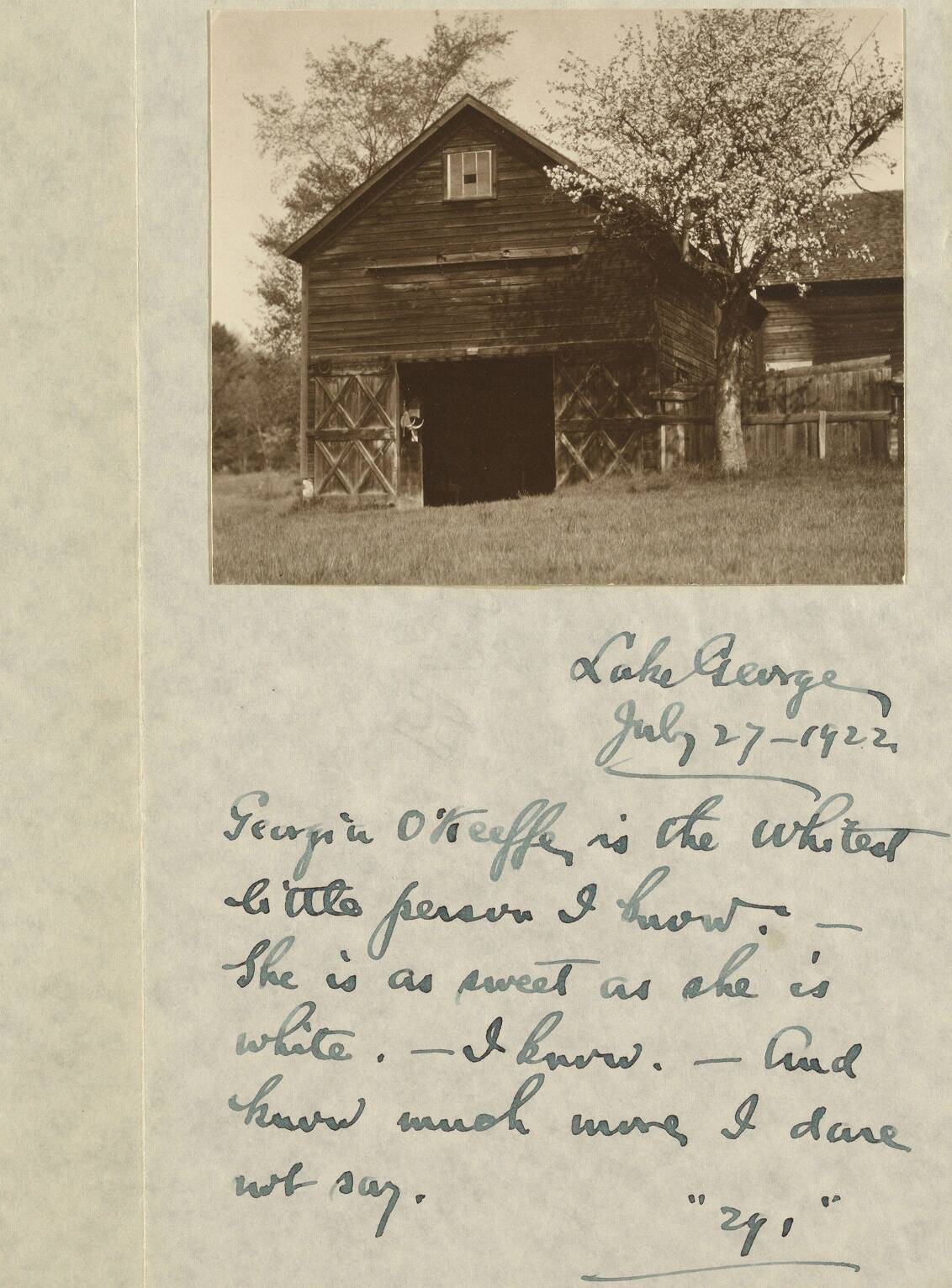
Photo: Alfred Stieglitz/Alamy
During the early 20th century, the American domestic imagination was captured by the botanist Luther Burbank, who was partially responsible for popularizing at-home nurseries and gardening, after inventing new creative strains of flowers like the Shasta daisy and the fire poppy. O’Keeffe likely learned of his work via Donald Davidson, who was the husband of Alfred Stieglitz’s niece. Davidson became a trusted friend and confidante during time spent out in the Adirondacks and helped yield apple trees in her yard through Burbank’s methods. Apples, petunias, and most prolifically poppies were among some of the seminal nature portraits that O’Keeffe painted in the close-up, magnified form that would become some of her most celebrated paintings today, often associated with the plains out West, but formed in Lake George. Two years ago, one of O’Keeffe’s paintings of a fire red poppy (the ones invented by Burbank) sold at Christie’s for $16.5 million. She painted it in 1928, the same year she wrote to Ettie Stettheimer: “I like it when I know there is no one nearby—and that it is all dark and uninviting outside.” Her singular language of abstraction was also first sharpened in this period. At Lake George, she let her mind run unchecked, writing to Anderson a long letter of musings about form. “There are several million of us—have we all a form?” she writes, signing off, “I’m getting twisted.” Her 1919 painting Series I, No. 10 is a layered work in deep blues and soft greens. The most literal forms are the indigo mountains, with some swampy foliage before them; the foremost ghostly layer, two mounds squeezed together, evoking knees as seen from rowing in a canoe. She reports to Anderson in the same letter: “I feel that a real living form is the natural result of the individuals [sic] effort to create the living thing out of the adventure of his spirit into the unknown.” This use of representation at Lake George would prove to be a pathway for her dual expression of emotions—loneliness and claustrophobia—but also her joy in solitude and nature. By the 1930s, O’Keeffe’s time at Lake George had slowed down, as she made Ghost Ranch her permanent home. Her marriage to Stieglitz had also grown strained and complicated. Her last visit upstate was to bury his ashes at the lake, among the roots of a tree near the water, shortly after his death. It was in 1946, the same year that she began the restoration of an adobe hacienda in Abiquiú that would become her studio and the place she called home for the rest of her life.

Annie Armstrong is a former reporter and columnist at Artnet News. Her work has appeared in New York Magazine, The New York Times, and GQ.